




Finance is the cornerstone of all programme and project delivery. The main concern for most is how much will be required, where will it come from and when will it be needed. There is a key concept where this information is encapsulated and that is the document called the Business Case.
All programmes, projects and changes costs money. It is important that there is prudent budgeting for all the costs that are likely to be incurred during the life of the project.
It is a common mistake to underestimate many of the costs associated with a project. In particular, the impact on internal resources is often overlooked focusing only on budget requirements for expenditure that will actually leave the organisation.
The scope of the Finance and Business Case management theme includes:
|
As a minimum, all initiatives will have:
|
|
||||
The focus of finance is different at programme level because:
Programmes and Project relationships
When planning for the structure of the budget it is necessary to take into account the layers.
Programmes may have a mix of projects and work streams reporting into them. As such a hierarchal budget is required.
Programmes themselves don't tend to spend a lot of money directly, this is normally done through the projects, but the accountable authority to spend that money sits with the programme board.
The programme will take an aggregated view of all costs whilst the projects will have a detailed view of their specific costs. Budgets can therefore be structured and allocated to projects, particularly elements within them.
Having the tiers of budgets is an important part of delegation. The programme would delegate elements of the budget and individuals within each layer would then be given financial authority to approve expenditure against their plan and budget.
|
Project Role/Activities |
Programme Manager |
Project Executive |
Project Manager |
Senior User |
Head of Portfolio |
Business Architect |
Business Analysis |
Portfolio Office |
|
Development of the project commercial plan |
Approves |
Authorises |
Actions |
Approves |
Assures |
Actions |
Actions |
Advises |
|
Identification of costs |
Approves |
Authorises |
Actions |
Approves |
Assures |
Advises |
Actions |
Advises |
|
Analysis and profiling of benefits |
Approves |
Authorises |
Actions |
Approves |
Assures |
Advises |
Actions |
Advises |
|
Undertaking cost benefits analysis |
Approves |
Authorises |
Actions |
Approves |
Assures |
Advises |
Advises |
Advises |
|
Developing the financial plan |
Approves |
Authorises |
Actions |
Approves |
Assures |
None |
None |
Advises |
|
Managing the financial delivery |
Approves |
Authorises |
Actions |
Approves |
Assures |
None |
None |
Advises |
|
Reviewing the effectiveness of financial management |
Approves |
Authorises |
Actions |
Approves |
Action |
None |
None |
Advises |
|
Programme Role/Activities |
Senior Responsible Owner |
Business Change Manager |
Programme Manager |
Head of Portfolio |
Business Architect |
Portfolio Office |
|
Development of the programme Financial Strategy |
Authorises |
Advises |
Actions |
Assures |
Actions |
Advises |
|
Development of the programme Commercial Strategy |
Authorises |
Advises |
Actions |
Assures |
Actions |
Advises |
|
Development of the programme business guest |
Authorises |
Advises |
Actions |
Assures |
Actions |
Advises |
|
Identification of benefits |
Authorises |
Actions |
Approves |
Assures |
Actions |
Advises |
|
Analysis and profiling of benefits |
Authorises |
Actions |
Approves |
Assures |
Actions |
Advises |
|
Developing the benefits plan |
Authorises |
Actions |
Approves |
Assures |
Actions |
Advises |
|
Development of the programme financial expenditure plans |
Authorises |
Advises |
Actions |
Assures |
Actions |
Advises |
|
Managing the benefits delivery |
Authorises |
Actions |
Approves |
Assures |
Actions |
Advises |
|
Reviewing the effectiveness of financial management |
Authorises |
Actions |
Approves |
Actions |
Advises |
Advises |
Role Key:
|
Accountabilities |
"Authorises" - provides the Board endorsement that the activity has been undertaken |
|
"Approves" - provides business approval of the result of the activity |
|
|
Responsibilities |
"Actions" - responsible for ensuring the activity is undertaken effectively, can be delegated |
|
"Advises" - provides guidance and help where needed |
|
|
"Assurance" - formal independent review |
Click the stages in the cycle diagram to go to the relevant page:
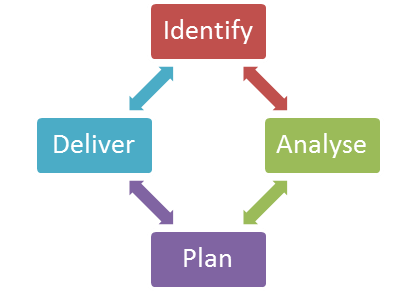
As with all themes in the framework, the process for budgeting is cyclical. This happens in parallel with a number of other themes, in particular, planning.
Costs are identified initially, it is important to capture all the possible sources of cost.
There is also the need to identify where the money is coming from, this may be complex and from multiple sources.
Costs are then categorised and analysed to confirm which ones apply and more detail gathered on the potential size and reliability of the costs. The main source of information will be the project or Programme Plan which will be assessing what will be required.
The plan will be forecasting expenditure and identifying sources of income to meet this expenditure.
Delivery covers the tracking and delivery of effective financial performance and reviews to ensure that management of delivery is optimised.
Costs will mainly come from the following areas; these are set out in more detail in the how2guide.
Project delivery costs will often be the external expenditure part of budgets as they will be paid to the suppliers (either internal or external).
It is important to understand the costs that are being provided - are they estimates of time and materials or are they estimates of fixed cost? What is excluded from quotes that you may need to budget for now, rather than be embarrassed later?
Business change costs are often massively underestimated. There are many costs that are not included in budgets because either they are overlooked or the business thinks that it can absorb them.
These are the costs of preparing, training, moving and supporting an operational unit until new practices are embedded. This could include interim operational resources required to embed the change.
Programme and project management costs - these are mainly the overhead costs, they are the management costs of running the project or the programme well and with the right resources.
Some roles will be full-time and some not, they should all have an estimate of the time that will be required and included in the budget. Decisions will need to be made about how these costs will be handled, there is no such thing as "free effort". If the roles are being supplemented with less experienced staff this may be cheaper, but budgets for assurance will need to go up.
Capital costs are normally for fixed assets. In accountancy terms the impact of these costs will often be spread over a number of years. Capitalisation is a specific financial technique and financial advice should be sought.
Capitalisation enables the cost of an asset that is expected to have a lifespan into future years, so the "value" will be enjoyed for years to come to be "accounted" for in the annual budgets so that it is not a one off cost, which can avoid annual budgets appearing to be negative and spreading the cost over future years.
Benefits and evaluation costs are those associated with the achievement of benefits or evaluating the effect of a policy impact. They are likely to occur in the latter stages of the lifecycle of the project or programme and there is a danger that they are left out of the budget or Business Case.
These costs can include setting up and implementing measurement, monitoring and reporting on benefits realisation. There may be additional costs to achieving benefits that are not part of the project costs and need to be included.
These costs can be seen as one off or offset against the actual benefit. If the cost of achieving the benefit outweighs the benefit then that may well help make the right decisions.
Costs come from many areas in a programme or project and the process of identifying, analysing and tracking should be on-going through the lifecycle. It is essential to maintain this focus on costs throughout the lifecycle to ensure the programme or project remains within budget. If costs rise unexpectedly, it may be necessary to make adjustments which could result in a change of scope; quality or necessitate a complete change in approach. Any of these impacts could result in a significant shortfall in the benefits proposed at the outset and reduced value for money.
It is important to remember that costs are being accrued from the moment the initiative begins to move forward.
It is even more important to remember that estimation of cost is directly linked to the estimates in the programme or Project Plan - so the expenditure will be directly linked to the progress in the schedule. These costs should be tracked from the outset, even if it is mainly focused on tracking staff time, remember - time costs money.
The organisation will have to balance cash flow across a number of projects and programmes in order to meet the commitments it has made to provide funding. Individual projects within the portfolio need to plan how they drawdown monies against agreed funding.
Deviations from the plan need to be reported so that the cash flow at portfolio level can be adjusted. An understanding of the relationship between management accounting, projects budgeting and cost management is helpful.
There are basically 3 areas where costs will be incurred:
There are a number of ways that costs can be undertaken. It is important to remember that estimation is not a one off activity, it should be happening through the life of the project or programme.
There are a number of techniques that can be used to minimise rises in costs. A key activity when developing the costs should be to seek out lessons learned from organisations that have done it before. To ensure that nothing is forgotten - create a schedule of costs sometimes known as a cost account. Identify and itemise all of the costs which you should then update as they are confirmed.
Understand and record any dependencies so that you can build in time and cost contingencies. Secure the prices you have agreed upon by purchase order or contract.
When considering contracts, include damages clauses in both so that you are able to recover some of the additional costs you may incur e.g. due to late or non-delivery.
Check any conditions which may arise from the source of funding as these may add to the cost of your project. European funding, for example comes with very prescribed set up and monitoring arrangements which can be costly to implement.
These are some places where you can investigate and analyse potential costs:
The budget will normally be created based on the 3 main sources of cost:
The budget is the total cost of the programme or budget and should include any contingencies to cover risks or other eventualities. The costs should be broken down by the preferred categories so that the various options can be compared "like for like".
Create the expenditure forecast
Expenditure forecasts are very straight forward, but also very important. It is a time-based forecast which shows where the money will be spent and when.
Where the project is depending on finance from a variety of sources, the income will need to match the expenditure forecast. For large projects, matching release of finance with expenditure forecasts is a critical element.
An area to consider is how to manage pricing; there are mainly 2 options, fixed or time and materials (sometimes called T&M). Prices can be fixed in a number of ways:
Time and materials is used when time or amount of materials is unknown or may be subject to change and you pay for effort as it is incurred.
Allow a sum for contingency which should be adequate to cover any cost increases outside of your control. This is not, however, to be used to mop up additional costs caused by a lack of robust estimating or planning. Costs or a proportion of the costs which may be incurred due to risks being realised should also be included, but listed and managed separately. Additionally, it is required that public sector projects or programmes should have allowances made for contingent liabilities - situations that you would hope never arise, but could happen nevertheless.
There is a different accounting treatment for these and whilst you would have to identify what these might be and what the likely cost would be, they would not come out of your project budget. Check with your Finance team to confirm these arrangements.
This stage is principally focused on forecasting and tracking performance and reacting to changes.
To track finance performance, you will need to monitor some of the following to check that the performance and delivery matches the plan.
|
Labour/Staff |
Equipment |
Overheads |
|
|
|
When tracking costs there are 3 areas to consider:
|
Spent |
Committed |
Planned |
|
This is the money that has already gone and has been spent on labour, equipment or overheads. |
This is a commitment to spend money on something. This would normally be linked to contractual arrangements through orders or procurement where cancellation is not possible. |
Expenditure that is expected to be required but where no binding commitment has yet been entered into. |
Events that affect the viability of the project or programme will almost certainly have an impact on the budget:
As part of the effective management of finance, project and Programme Managers should always be aware of:
There are many component parts of the Business Case. It contains all of the documents that provide the evidence which justifies a project or programme. It evolves over time as early assumptions are confirmed or otherwise.
Even at the very early Idea and Incubation stages, a number of options should be on the table. One of them must be a "do nothing" option which is vital in determining whether anything needs to be done at all.
If you are running a compliance programme this will give you the justification to change, e.g. the costs/impact of not changing. There should always be at least 3 reasonable options to consider, which means that at least 3 potential operating models will need to be developed to enable proper analysis of each and provide a conclusion as to which option provides optimum benefits and value for money.
Secondly, there are the benefits. These are covered at length within the Benefits Management elements of this framework. The work to identify and analyse benefits provides an essential input into the Business Case.
Then you need to consider the costs. Each option will have different approaches and in fact a preferred option may also have a number of delivery methods. The Business Case should include the costs for each of these and the associated level of risks with the estimated benefits. The majority of the costs are associated with the projects.
Once approved, the key review points are at the end of stages, when the viability is reassessed and decisions to continue, change direction or stop are made.
The Business Case evolves during the programme or project; it shouldn't be a document that is created at the end of the Design phase to sell the justification for expenditure (despite the reality of most organisations). It is a concept that is evolving through a number of pieces of information and grows in maturity.
Strategic Outline Business Case - this is the scoping stage. At this point the strategic context and case for change is confirmed. Engage stakeholders providing some idea of the possible way forward on a wide range of options. This is created by the end of Initiating the Change.
Outline Business Case - the envisaged 'deal' is outlined; key contract clauses and payment mechanisms will have been agreed; will include detailed analysis of finances and any remaining gaps in funding; the delivery plan, although not finalised, will have been developed further. This is created by the end of Define, either programme or project.
Full Business Case - this builds on the outline Business Case and adds the result of any procurement to provide more certainty over the costs. Detailed delivery plan will have been prepared and there should not be any gaps in funding at this stage. The Benefits Realisation Plan and evaluation plan should also be included. The full Business Case is created at the end of Design, either programme or project.
We hope you find value in this public version. If you would like your own bespoke framework or would like to talk through the framework with us, please contact us at contactme@aspireeurope.com.