




Management control covers the internal activities that are focused on ensuring that the initiative delivers on time, to an acceptable level of quality and meets the business requirements.
One of the major causes of programme and project failure is lack of control once an initiative moves into delivery. The scope can include a range of topics, some of which we have dispersed into other techniques
Within Management Control we have included the following topics:
|
As a minimum, all initiatives will have
|
|
||||
Management Control is different at the programme level because:
The focus of quality is different at the programme level because:
|
Project Role/Activities |
Programme Manager |
Project Executive |
Project Manager |
Senior User |
Head of Portfolio |
Business Architect |
Business Analyst |
Portfolio office |
| Set up the Assurance Plan |
Approves |
Authorises |
Actions |
Approves |
Assures |
None |
None |
Advises |
|
Defining and managing delivery within scope |
Approves |
Authorises |
Actions |
Approves |
Assures |
None |
None |
Advises |
|
Maintain control in line with the Align Framework lifecycle and decision gates |
Approves |
Authorises |
Actions |
Approves |
Assures |
None |
None |
Advises |
|
Impact assessment and control of changes |
Approves |
Authorises |
Actions |
Approves |
Assures |
None |
None |
Advises |
|
Progress reporting against success factors |
Approves |
Authorises |
Actions |
Approves |
Assures |
None |
None |
Advises |
|
Tracking of dependencies from other projects |
Approves |
Authorises |
Actions |
Approves |
Assures |
None |
None |
Advises |
|
Quality specification and acceptance procedures |
Approves |
Authorises |
Actions |
Approves |
Assures |
None |
None |
Advises |
|
Scaling controls appropriately |
Approves |
Authorises |
Actions |
Approves |
Assures |
None |
None |
Advises |
|
Programme Role/Activities |
Senior Responsible Owner |
Business Change Manager |
Programme Manager |
Head of Portfolio |
Portfolio office |
|
Development of the programme Management Controls strategy |
Authorises |
Approves |
Actions |
Assures |
Advises |
| Establish the Integrated Assurance Strategy |
Authorises |
Approves |
Actions |
Assures |
Advises |
|
Managing project delivery within scope |
Authorises |
Approves |
Actions |
Assures |
Advises |
|
Maintain control in line with the Align Framework lifecycle and decision gates |
Authorises |
Approves |
Actions |
Assures |
Advises |
|
Management and control of changes across the programme |
Authorises |
Approves |
Actions |
Assures |
Advises |
|
Control of changes to dependencies internal and external to the programme |
Authorises |
Approves |
Actions |
Assures |
Advises |
|
Programme monitoring and reporting |
Authorises |
Approves |
Actions |
Assures |
Advises |
|
Scaling controls appropriately for projects |
Authorises |
Approves |
Actions |
Approves |
Advises |
|
Review of programme controls effectiveness |
Authorises |
Approves |
Actions |
Approves |
Advises |
Role Key:
|
Accountabilities |
"Authorises" - provides the Board endorsement that the activity has been undertaken |
|
"Approves" - provides business approval of the result of the activity |
|
|
Responsibilities |
"Actions" - responsible for ensuring the activity is undertaken effectively, can be delegated |
|
"Advises" - provides guidance and help where needed |
|
|
"Assurance" - formal independent review |
The delivery lifecycle defines the journey of an idea from concept to delivery, it is designed in a flexible way to enable policy teams to evolve concepts, under control, that may or may not lead to a project at some stage.
The lifecycle provides a number of pre-determined stages that all initiatives will follow, each stage is made up of a number of milestones that provide the consistency and visibility of project progression across the organisation.
The lifecycle has guidance on how to move between the milestones and the areas that need to be considered.
The lifecycle only defines the management milestones for tracking progress. Each programme and project will have unique activities that it will need to achieve. Therefore, it is likely that a number of specific milestones and activities will be required to reflect the scale and nature of the programme or project.
Additionally, for simple projects it may be possible to pass through certain milestones very quickly as little work will be required. The milestones in that situation can act as a checklist to ensure nothing has been missed. For larger programmes, each milestone may take months or even years.
The key value of a consistent set of milestones is that at the portfolio level the progress towards completion can be easily tracked and assessed.
The end of each of the lifecycle stages will involve a decision gate review to decide if the project or programme is still viable - this is a fundamental basis for the control.
Scope Management and Progress Tracking
The most common cause of project failure is the lack of clarity and definition around the scope and business requirements. This leads to inappropriate expectations being set for stakeholders and difficulty in identifying and delivering the correct solution.
The initiation documentation should clearly state what will be delivered and when. There should be an operating model that sets out not just the products (deliverables) that will be created, but how will they be deployed to deliver outcomes that will improve operations or performance.
The scope of the change should see the full impact of the outcomes, not just focusing on what it will create. Consequently, impact assessments of change can be effectively carried out.
There should be robust and regular progress reporting that focuses on ensuring that the programme and project are progressing towards achieving their objectives.
The scaling of the project controls are linked to the risk profile assessment, which will diagnose the complexity and difficulty of the change. This will be affected by many factors, including:
The Risk Profile Assessment will allocate the project a level of High, Medium or Low risk.
All projects will follow the common lifecycle; however, the levels of control for a high risk change will be more robust than those for a low risk change.
At the outset of the change, there is often ambiguity about what is going to be achieved; however, working to clear the ambiguity is key aspect early in the lifecycle. This will require engagement at a number of levels.
The Project Executive will need to clarify the strategic context and constraints within which the project should deliver. These will provide the top level objectives resulting from the discussions with the stakeholders.
Objectives can be categorised as follows:
Failure to capture this holistic view of what is required through the objectives can be attributed to many perceived project failures.
As a rule of thumb, all objectives should be:
Quality management in a programme or project is a very wide ranging topic. For the purposes of management control it is focused on delivering the outputs and capability to a standard that is acceptable to deliver the change.
Outputs (PRINCE2 calls them products) can range from a document to a bridge - each has to be produced to a particular standard to be acceptable.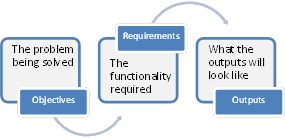
At programme level quality is associated with the management processes. The outcomes are defined in the blueprint which is delivered by the projects, so the focus of this section is on project quality.
Quality is the definition of what success will look like. It is the functionality and quality of the outputs. This is derived from the objectives which outline the problem being solved; the requirements which are what is needed to solve the problem and the outputs are the assets that will be used.
Managing quality is about getting the outputs right first time. What the project doesn't want to happen is for something different to turn up on site on the day of installation to what was required.
The other aspect to quality is the evolving expectations of stakeholders, who may have specified one thing, but in their view it becomes morphed into something completely different through over publicising the benefits or the positives. These are the sources of perceived project failures.
Quality is managed by measuring and monitoring the quality of the outputs being developed against the quality criteria during design and development rather than wait to see the finished article, after much time and effort may have been wasted creating the wrong thing.
The sources of acceptable criteria were defined in the product descriptions and these should provide the basis for the assessment process. Managing the progress towards the delivery of the product may be defined in terms of establishing reviews at points where deviations can be managed, namely:
Each of these may trigger payments if a supplier is involved, which is a good way to control the expenditure related to value delivered. These steps could also be used to measure percentage of the task completed.
Reviews can take two forms, a formal scheduled review and/or spot checks on progress.
Opportunities may arise through the quality control process to deliver requirements that were identified at the outset, but were not left out of scope as they were categorised as "nice to haves", this in turn increases the value to the operations, or a completely new opportunity may arise unexpectedly.
Changes to quality should be regarded as issues and follow the change control procedures. Any changes to requirements from either the supplier or the customer will have a time and cost impact which must be assessed.
There are three major areas of control in a project:
The project must manage these dimensions as a change to one will affect the other. If the project runs late, it will consume more resources and cost more. The only way to affect this is to change the scope and reduce the quality requirements or amount of what is delivered, this will enable the project to re-plan, claw back time and achieve its objectives within the same resources (cost).
To manage this effectively, it is essential that internal and external resources are calculated.
Tolerance therefore can be allocated against:
Remember that projects run a year late one day at a time. Once time slips it cannot be made up without re-planning and changes to the way it is being delivered (taking corrective action). The challenge is to manage drift of costs, time or quality that aggregates below the radar and becomes transparent later in the day.
There are various definitions of what integrated assurance means, but this one from Beyond Boundaries (Kubitscheck, Gower) seems to encapsulate the key points: “Integrated assurance refers to a structured approach for gaining a holistic picture of the principal risks and the level of residual exposure an organisation is required to manage. It involves aligning and optimising the organisation’s assurance over the management of those risks and core business activities in line with the board’s risk appetite and exists to support the board’s risk oversight and risk taking”. Assurance gives confidence to the key stakeholders that plans and objectives are achievable.
Main forms of assurance that are generally available are:
This article explains how to achieve this integration.
We hope you find value in this public version. If you would like your own bespoke framework or would like to talk through the framework with us, please contact us at contactme@aspireeurope.com.