




A stakeholder is anyone with an interest in the project or programme and could have positive or negative attitude to the changes that are being delivered.
There needs to be thorough consideration of: who the potential stakeholders are; why they are being affected; their potential impact on the programme, and; how they will be communicated with.
Stakeholder resistance is a common risk for most programmes and project. As such it needs to be addressed at the outset to minimise the potential impact.
|
As a minimum, all initiatives will have:
|
|
Programmes will be more complex and the priority of stakeholder engagement should be higher. The key areas to consider are:
|
Project Role/Activities |
Programme Manager |
Project Executive |
Project Manager |
Senior User |
Business Architect |
Business analysis |
Portfolio Office |
|
Identifying stakeholders |
Approves |
Authorises |
Actions |
Approves |
Advises |
Advises |
Advises |
|
Analysing and profiling stakeholders |
Approves |
Authorises |
Actions |
Approves |
Advises |
Advises |
Advises |
|
Planning communications |
Approves |
Authorises |
Actions |
Approves |
Advises |
Advises |
Advises |
|
Managing and delivering the communications plan |
Approves |
Authorises |
Actions |
Approves |
Advises |
Advises |
Advises |
|
Managing feedback from stakeholders |
Approves |
Authorises |
Actions |
Approves |
Advises |
Advises |
Advises |
|
Programme Role/Activities |
Senior Responsible Owner |
Business Change Manager |
Programme Manager |
Head of Portfolio |
Portfolio Office |
|
Developing the programme Stakeholder Engagement Strategy |
Authorises |
Approves |
Actions |
Assures |
Advises |
|
Identifying stakeholders |
Authorises |
Approves |
Actions |
Assures |
Advises |
|
Analysing and profiling stakeholders |
Authorises |
Approves |
Actions |
Assures |
Advises |
|
Developing the programme communications plain |
Authorises |
Approves |
Actions |
Assures |
Advises |
|
Aligning programme with project communications |
Authorises |
Approves |
Actions |
Assures |
Advises |
|
Identification and management of inter project and inter programme dependencies |
Authorises |
Approves |
Actions |
Approves |
Advises |
|
Managing and delivering the communications plan |
Authorises |
Approves |
Actions |
Assures |
Advises |
|
Managing feedback from stakeholders |
Authorises |
Approves |
Actions |
Assures |
Advises |
Role Key:
|
Accountabilities |
"Authorises" - provides the Board endorsement that the activity has been undertaken |
|
"Approves" - provides business approval of the result of the activity |
|
|
Responsibilities |
"Actions" - responsible for ensuring the activity is undertaken effectively, can be delegated |
|
"Advises" - provides guidance and help where needed |
|
|
"Assurance" - formal independent review |
Click the stages in the cycle diagram to go to the relevant page:
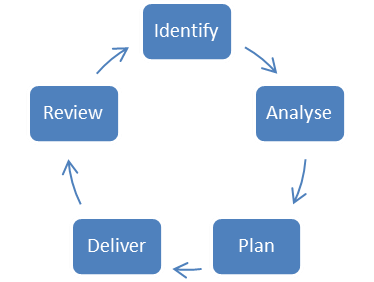
Throughout the programme or project lifecycle there is guidance on the stakeholder theme and at each milestone you will find advice on specific areas which need attention.
There is a recurring cycle that should be followed throughout the lifecycle of the programme or project, this section provides advice to support this.
Click on the relevant part of the cycle to find out more with techniques and guidance.
The stakeholder management cycle begins with identification of all stakeholders that are involved in or affected by the project or programme and their outcomes. During the life of the project/programme new stakeholders will be identified and stakeholders will change. Their importance or potential impact on the project/programme will vary and change throughout the cycle.
Projects and Programmes often have vast numbers of stakeholders and therefore it is very useful when identifying stakeholders to categorise them into groups. By grouping Stakeholders at the outset, allows messages to be organised and targeted at certain groups immediately. This allows relevant and key messages to be sent to different sets of stakeholders.
It is tempting to create of list of people that you know will be directly affected without standing back and thinking about the bigger picture or the knock on effects of the changes.
In order to take the a comprehensive perspective on who the stakeholders are, a workshop style activity should be undertaken to collectively ascertain which individuals and groups are likely to be affected.
This step in the cycle should produce a stakeholder map, this is the matrix showing who the stakeholders are and the areas of the programme they are interested in.
HR or corporate communications may already have grouping for internal and external groups that will make a useful starting point.
When analysing the stakeholders there are a number of things you should consider:
By assessment of the above it will be possible to create a more effective communications plan to target specific groups and provide the information they will need to reduce the resistance and subsequently gain their support and/or involvement.
The analysis should be undertaken as a group activity to help avoid individual subjective judgement being applied.
Further Stakeholder Analysis:
You may wish to undertake further analysis, which could include:
Consider:
The communications plan should be developed from the earlier stakeholder analysis. It should state how communications are going to be released in a timely manner and contain messages which engage, inform and maintain the right level of interest.
There are two specific types of communications that you need to plan for:
1. "Announcement" type communication where specific information is released to have an effect. This could be related to a specific group of stakeholders, for example, acknowledging an achievement or one off event like a conference to deal with specific issues.
2. "Drumbeat" type communications which are about maintaining awareness, emphasising messages that have been released in the past so that they are not forgotten or setting the scene for upcoming announcements, for example, a newsletter or website.
The plan should include both types of communications and should also include details to cover:
This is the management of the communications plan and ensuring that it is achieving the objectives. It is very likely that there will be unexpected events to deal with and there may be stakeholders who are actively deploying communications that are having a negative effect which will need to be reacted to.
It is important that the communications and reactions are being tracked so that there is an audit trail of what is happening. The plan can then be adjusted accordingly to meet the changing levels of engagement and support.
It is important that feedback is handled effectively. Comments, requests for more information or views being expressed should be logged and responded to.
If there is likely to be a lot of feedback then you could maintain a comments log. For smaller projects you can include them in the Issue Log to be dealt with.
The review of effectiveness should happen as the programme or project approaches each of the milestones.
The stakeholder landscape will be evolving as you move through the programme or project lifecycle, so the information and plans must remain aligned. The review is the opportunity to learn lessons and realign the analysis and plans.
When reviewing the effectiveness of stakeholder management, the following should be considered:
a. What lessons have been learned so far?
b. Are the stakeholders groups still valid, have new ones appeared or do the groupings need to be re-organised?
c. Are there new areas of interest to be included?
d. Is the analysis of each group still correct?
e. Which communications channels have been most effective?
f. What are the levels of feedback and how effectively are these being dealt with?
The cycle of re-identification, analysis, planning and delivering runs again through to the next milestone.
We hope you find value in this public version. If you would like your own bespoke framework or would like to talk through the framework with us, please contact us at contactme@aspireeurope.com.