




Benefits are the justification for most investments as they are the measure of the improvement that will be enjoyed by the organisation.
A benefit is a positive effect of the change for the organisation. However, it may not be seen as positive by all stakeholders. To be a benefit it must be clearly defined, the result of outcomes, measurable and attributable to an individual or group. This way you know where it will turn up. Benefits should be measured financially.
Delivering the benefits from an investment invariably involves the delivery of organisational change and as such is often the most difficult part of a programme or project; therefore benefits must be at the heart of the decision making for programme and project boards. Benefits are the positive effects of change as defined in the blueprint; therefore there is an inherent link between the blueprint and the benefits.
|
As a minimum, all initiatives will have
|
|
||||
Programmes will have much more focus on the blueprint/operating model, this will be created before the projects are initiated, as it provides the basis for the project requirements.
Benefits will be aggregated across a number of the projects, so there will be more focus on benefits than for a project
The type of the programme will significantly affect the approach to benefits:
Vision led programmes will be the most benefits focused. By their nature they are higher risk and as such the anticipated rewards will be expected to be higher. Analysis will be needed into the potential benefits from the change and there is advantage gained from being a "first mover".
Emergent programmes may initially be focused on the added value from optimising the delivery of projects however the aggregated value of the benefits across the various initiatives. Quite often there are initiatives that are struggling to justify themselves as standalone projects but, when constituted as a programme, the potential is much greater.
Compliance programmes are often the most difficult to develop the benefits for. This is because there is little or no choice about the changes that have to be made, only the level of ambition. These programmes can be driven by legislative changes like carbon emissions, market changes and the need to maintain position, or in the public sector, implementing political changes that are based on philosophy rather than benefits. In these situations, the benefits are often the avoidance of the consequences of not taking action, and they may not match the cost of the programme at all.
|
Project Role/Activities |
Programme Manager |
Project Executive |
Project Manager |
Senior User |
Head of Portfolio |
Business Architect |
Business Analysis |
Portfolio Office |
|
Identification of benefits |
Approves |
Authorises |
Advises |
Approves |
Advises |
Advises |
Actions |
Advises |
|
Analysis and profiling of benefits |
Approves |
Authorises |
Advises |
Approves |
Advises |
Advises |
Actions |
Advises |
|
Developing the benefits plan |
Approves |
Authorises |
Advises |
Approves |
Advises |
Advises |
Actions |
Advises |
|
Developing the business change plan |
Approves |
Authorises |
Advises |
Actions |
Advises |
Advises |
Actions |
Advises |
|
Managing the benefits delivery |
Approves |
Authorises |
Advises |
Approves |
Advises |
Advises |
Actions |
Advises |
|
Reviewing the effectiveness of benefits management |
Approves |
Authorises |
Advises |
Approves |
Advises |
Advises |
Actions |
Advises |
|
Managing compliance with organisation's change standards |
Authorises |
Approves |
Advises |
Assures |
Advises |
None |
None |
Advises |
|
Programme Role/Activities |
Senior Responsible Owner |
Business Change Manager |
Programme Manager |
Head of Portfolio |
Business Architect |
Portfolio Office |
|
Development of the programme Benefits Management Strategy |
Authorises |
Approves |
Actions |
Advises |
Approves |
Advises |
|
Development of business requirements and architecture |
Authorises |
Actions |
Authorises |
Advises |
Approves |
Advises |
|
Development of the programme Change Management Strategy |
Authorises |
Actions |
Authorises |
Approves |
Actions |
Advises |
|
Identification of benefits |
Authorises |
Actions |
Authorises |
Assures |
Approves |
Advises |
|
Analysis and profiling of benefits |
Authorises |
Actions |
Authorises |
Assures |
Approves |
Advises |
|
Developing the benefits plan |
Authorises |
Actions |
Authorises |
Assures |
Approves |
Advises |
|
Alignment with the organisations change management standards |
Authorises |
Actions |
Authorises |
Assures |
Approves |
Advises |
|
Managing the benefits delivery |
Authorises |
Actions |
Authorises |
Assures |
Approves |
Advises |
|
Reviewing the effectiveness of benefits management |
Authorises |
Actions |
Authorises |
Assures |
Approves |
Advises |
Role Key:
|
Accountabilities |
"Authorises" - provides the Board endorsement that the activity has been undertaken |
|
"Approves" - provides business approval of the result of the activity |
|
|
Responsibilities |
"Actions" - responsible for ensuring the activity is undertaken effectively, can be delegated |
|
"Advises" - provides guidance and help where needed |
|
|
"Assurance" - formal independent review |
The Benefits Management Cycle:
Click the stages in the cycle diagram to go to the relevant activity:
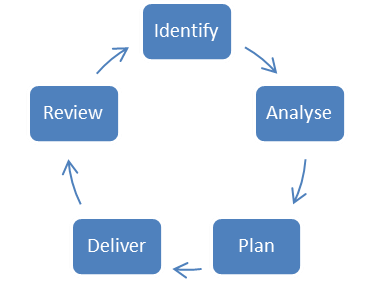
As with most of the themes there is a cycle of activities that run throughout the programme. It is your job to manage this cycle and ensure that it happens.
There are 5 steps that cover the evolution of benefits, their maintenance and monitoring during the lifecycle.
Major inputs to the benefits process are firstly business requirements that set out the problem to be solved and what the business requires to solve it.
The second input is the blueprint, which sets out the operating model that will be implemented when the programme or project completes. This contains details of how the operation works today and how it will work in the future.
These two inputs are at the core of calculating the benefits, without them the benefits will be guess work.
Identification begins right at the start of the programme, during Initiate the change, when the strategy is being developed and the benefits are first identified.
Initial places to look for benefits will include.
Corporate objectives - alignment and contribution to the achievement of the organisation's objectives
Programme blueprint - this should state the current and future states for the programme, which is where the benefits will be generated from
Internal sources - improvements internal to the organisation
External sources - improvements delivered to the supply chain, economy or consumers
The reason that the change is initiated will often affect the types of benefits that can be pursued. If it is fundamentally compliance in nature, namely, doing nothing is not an option, and then the benefits may well be found in the avoidance of the negative consequence that would have resulted from doing nothing.
This is the step when you will create your initial benefit maps to illustrate what the programme will deliver so that there is an illustration of the cause and effect between the capability that is being produced and the benefits that are being forecast.
The business requirements will be constructed during the early stages. The calculation of the benefits will be linked as the benefits will come from the solving of a business problem which could be causing inefficiency or the exploitation of an opportunity for improvement.
Once the potential benefits have been identified, then they need to be systematically analysed to calculate their financial value, changes that need to happen to enable their delivery and the level of risk associated with the calculations.
Analysis should be undertaken concurrently with the development of the requirements and the blueprint that will be delivered. There will be a number of options considered - the one that delivers the most benefits is likely to be the preferred option for delivery.
Guidance on techniques for developing requirements and blueprinting should be referred to.
This work should be done in collaboration with the creation of the blueprint, as the capability being designed will need to deliver the changes that you need to achieve the benefits.
This is the step during which you will develop your Benefits Management Strategy and create your Benefit Profiles.
It is much better if benefits have a financial value allocated to them, it is important to be clear as to whether the achievement of this value is cashable or not. Failure to be clear on this is often the cause of lost or misunderstood benefits and the blame game will begin.
Cashable - those where the money is released by the organisation to reduce costs or for further investment
Non cashable - where an efficiency saving is achieved across a number of activities and provide the potential to do more, but no cash is released. This is often associated with FTE savings where there is the potential to do more, but there is a danger that saving is absorbed back into the organisation and the benefit is not delivered.
Both can be measured in financial terms, but understanding the difference is important where cost saving are required to be delivered, non-cashable benefits are of very little use for this.
Value types
It is important to note that for any particular change initiative there may be positive values against one value type, but with a negative impact on one of the other sources, for example, you might make an efficiency improvement but with a deterioration in service levels . Both measures need to be captured to enable the right management decisions to be made.
The three value types are:
|
Category |
Description |
|---|---|
|
Economic |
- Improved cash flow |
|
Efficiency |
- An efficiency is only a benefit if the resources are released to do other work or are no longer in place - Improvements that create an efficiency are |
|
Effective |
- Improvements that create an effectiveness are: - Less failures or complaints |
The value types are really helpful in finding benefits and tracking them during the programme, they also help to show how a new capability will have positive and negative effects.
There are two ways to plan, start at the beginning and work forward. This is the normal approach, but one of the problems is that the timing of the end doesn't fit with the strategic needs of the programme. The alternative is to start at the end and work backwards so that you can work out what needs to be done by when.
This benefits map is in reverse order, which some people find easier to deal with. It shows how a government, for example, might try to reduce costs.
Benefits must be consistently and appropriately measured to understand and track where and how the benefit will manifest itself, so the first thing to work out is what you will measure and the second is when the measurable improvements will occur.
These are the only measurement criteria that may be used and they must be supported by tangible measures, otherwise they will not be accepted. These are the measures that can be used to define the value of any benefits:
The measurement headings are:
|
Measurement |
Description |
|---|---|
|
Cash saving |
- Cashable reduction in the cost as a result of making the change - The amount of the saving must be attributable to a financial budget and be approved by the Financial Partner - This information must be aligned with corporate finance plan |
|
FTE Reduction |
- Reduced number of human resources used to deliver the service who can be released or re-deployed - The posts that will be affected must be identified, with specific reference to what activities will not now be undertaken, and how the released effort will be used |
|
Reduced Transaction time |
- Time it takes to deliver a service, either internally or externally. The time that is saved can then be turned into a measurable value - This must be illustrated with specific reference to the tasks that are no longer required, or the obstacle that is being removed which will enable the speeding up of the transaction |
|
Reduced failure rate |
- Service or product failures that are removed and the associated value of failures that are being avoided - This must be illustrated by analysis of the root cause of the failure and what are the impacts of these failures that justify their removal? |
|
Department Performance KPI's |
- Contributes to a change in an identified indicator, which in itself must have a measurable value to the organisation, in particular if that indicator supports a strategic objective - The specific indicator must be defined, and an explanation of how the indicator will be changed, and what the benefit of changing this indicator is |
|
Customer Satisfaction |
- Improvement in the satisfaction by the consumers of the service by a measurable amount. This measurable amount must be attributable to the planned change - There must be a description of the current levels of satisfaction, how this was measured, the level of change that is anticipated and how this improvement will be measured. |
A key part of planning is projecting the effects of the change on performance, putting in place contingency to cope with any potential deterioration performance and forecasting when and where the improvements will occur.
This is covered in more detail in the Transformational Flow process, where we look at the steps in the change and how you fit into this.
Implementation is directly linked to the delivery of the blueprint. The projects will be creating the capability for you, so you will need to be focused on when and where this will occur and what you need to do to make the change happen.
As part of the measurement you will have identified what the performance levels are on the indicators that you have chosen. This information should have been stored in the blueprint and/or the benefit profiles.
The target performance levels once the programme has completed will also have been estimated, as these will be the basis for the benefit calculations.
As the programme moves through delivery, maintaining a track of the anticipated performance levels against what was predicted is essential and part of the Change Delivery role. After initial implementation the performance is likely to be volatile, which is why time to allow the performance to stabilise is required before the benefits can be claimed.
As with all the themes there should be a regular review, as a minimum before each decision gate but also as the programme or project passes each milestone.
Throughout this process lessons are going to be learned that will need to be factored into the future benefits planning, some areas that will require monitoring and probably improvement will include:
We hope you find value in this public version. If you would like your own bespoke framework or would like to talk through the framework with us, please contact us at contactme@aspireeurope.com.